The Harrison Police Department releases information on the role parents and guardians can play in the ever increasing threat to young people through online interactions.
In a release posted on their Facebook Page, the department announces that several of their School Resource Officers participated in specialized training conducted in Little Rock. During that time, officers learned about the growth in certain networks promoting violence.
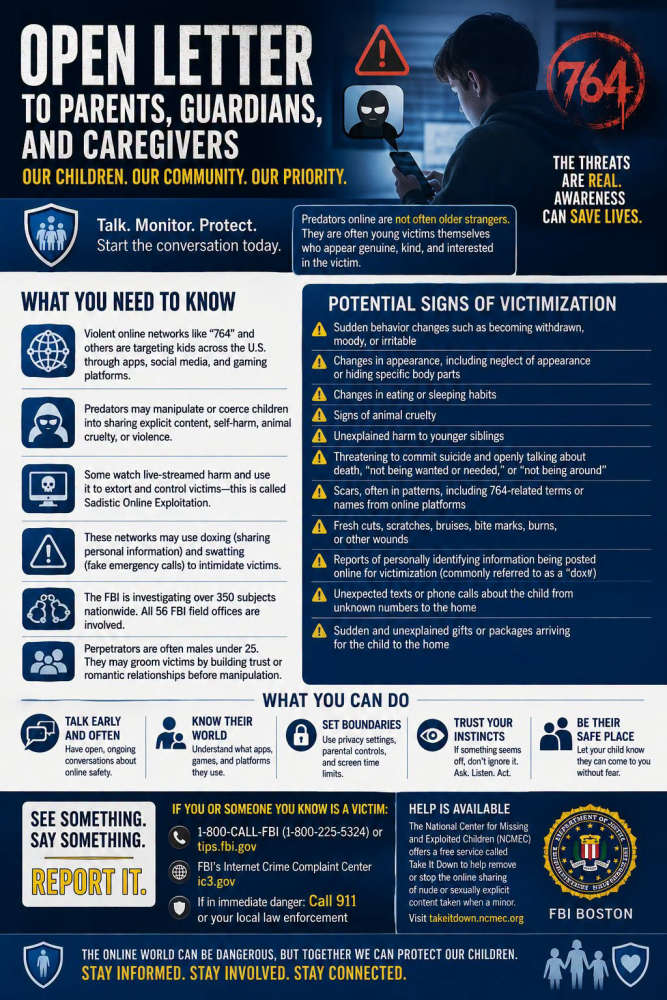
The post shared an open letter to parents published by the FBI's Boston Field Office earlier this year which gives information on these groups and helps parents start conversations about this threat. The letter includes information on some of the groups and some of the signs of influence by these online groups.
The full text of that letter from the Harrison Police Department Facebook Page is below:
Dear Parents and Guardians,
Our commitment to community safety starts with keeping you informed, especially when it comes to the safety and security of our children.
The FBI is extremely concerned about a sharp increase in the activity of "764" and other violent online networks targeting and exploiting children and other vulnerable individuals across the United States and here in New England. While these networks are often referred to as "764," there are many other offshoot networks and names.
Members of these networks connect with children and other at-risk individuals online through mobile messaging apps, social media and gaming platfornls, then manipulate or coerce them into producing and sharing graphic content, child sexual abuse material (CSAM), or engaging in acts of animal cruelty, self-harm, or violence. Some of these predators even watch live-streamed self- haml and other violent content and circulate it to continue to extort their victims and exert control. It's a tactic known as Sadistic Online Exploitation. Here in FBI Boston's area of responsibility, there have been instances where members of these networks have also utilized doxing and swatting as an intimidation tactic to coerce victims into performing increasingly degrading and violent acts.
The term Nihilistic Violent Extremism (NVE) refers to what is motivating most of these subjects to commit criminal acts. They want to sow chaos and facilitate the destruction of society. However, not alI participants in these violent online networks are motivated by NVE. These subjects may be engaging in criminal activity for sexual gratification, social status, a sense of belonging, or for a mix of other reasons. Each case is evaluated individualIy to detemline if Nihilistic Violent Extremism is involved. Regardless of motivation, the FBI takes each case seriously and works with its law enforcement partners, both domestic and foreign, to ensure offenders are held accountable.
The FBI is detemlined to identify and stop these criminal networks. Right now, we are investigating over 350 subjects nationwide who are tied to these violent online networks, and all 56 FBI iield offices across the country are involved in these investigations.
While many of the victims are young females, any child can be at risk. The perpetrators themselves are often males under the age of 25 and come from all walks of life. They often groom victims by first establishing a trusting or romantic relationship before eventually manipulating and coercing them into engaging in escalating hamlful behavior designed to shame and isolate them.
Awareness is the first step in prevention. It's critical that parents and guardians understand who their children are communicating with online and what platforms they are using. In many investigations involving online threats, parents believe they are aware of their child's activities
only to discover they didn't know what was truly happening. Have open, ongoing conversations with your child about the risks of sharing personal infonnation, images, or videos online. You can find helpful guidance here: FBLgov-How we can help
Potential signs of victimization include:
Sudden behavior changes such as becoming withdrawn, moody, or irritable
Changes in appearance, including neglect of appearance or hiding specific body parts
Changes in eating or sleeping habits
Signs of animal cruelty
Unexplained harm to younger siblings
Threatening to commit suicide and openly talking about death, "not being wanted or needed," or "not being around"
Scars, often in patterns, including 764-related terms or names from online platforms
Fresh cuts, scratches, bruises, bite marks, burns, or other wounds
Reports of personally identifying information being posted online for victimization (commonly referred to as a "dox")
Unexpected texts or phone calls about the child from unknown numbers to the home
Sudden and unexplained gifts or packages arriving for the child to the home
If you or someone you know is a victim of a crime using these kinds of tactics, retain all information from the incident such as usernames, email addresses, websites, or names of platforms used, and immediately report it to 1-800-CALL-FBI (1-800-225-5324) or tips.fbi.gov. The FBI's Internet Crime Complaint Center at ic3.gov.
If anyone feels they are in imminent danger, please reach out to local law enforcement immediately.
The National Center for Missing and Exploited Children (NCMEC) provides a free service known as Take It Down, which helps minor victims, or adults who were victimized as minors, with removing or stopping the online sharing of nude or sexually explicit content taken while under 18 years old. For more information, visit httpshttps://takeitdown.ncmec.org/ .
The threats our children face online are real and growing. But with awareness, vigilance and cooperation, we can stop these predators before they cause harm. Your role is critical. By staying informed and engaged, you become the first line of defense in protecting our children. The FBI is steadfast in this mission, and we are proud to stand with you in the fight to keep our children safe.
Respectfully,
Ted E. Docks
Special Agent in Charge
 Branson Schools Announces New Executive Director of Operations
 Pioneering Quality in the Steel Industry
 Can a Contractor Take Over Your Home
 Frozen Pipes, Hot Water Heaters, and Dishwasher Mishaps
 Choosing the Right Trailer: A Comprehensive Guide